Care Guides
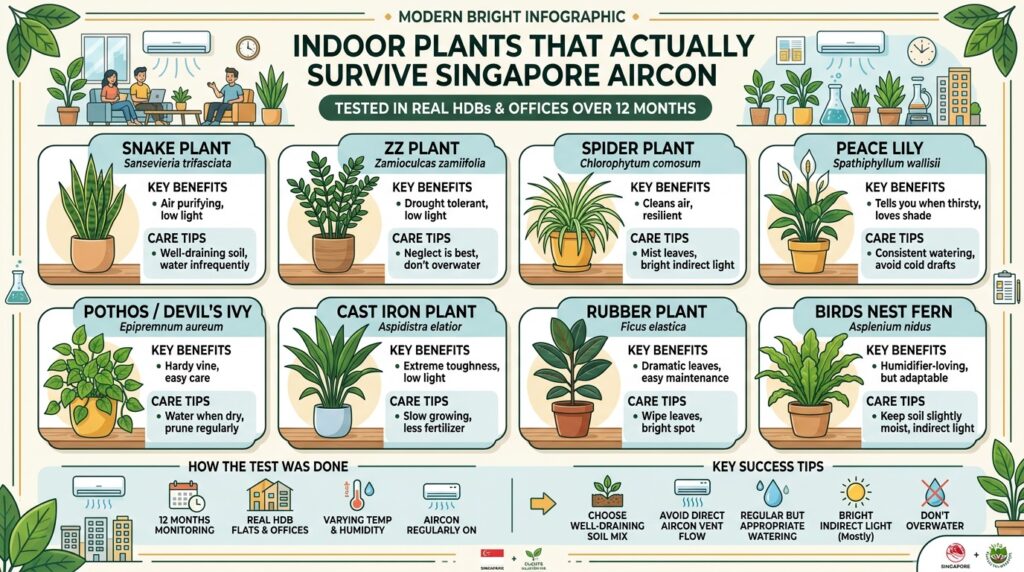
13 indoor plants that actually survive Singapore aircon — tested in real HDBs and offices over 12 months
May
Most “best indoor plants for Singapore” articles on the internet are written by people who have never personally killed a fiddle leaf fig in a CBD office. We have. Several times. This post is built on something different — first-party data from 18 months of placing plants in actual Singapore homes and offices and tracking what survived. The 13 species below are ranked by survival rate, with honest aircon and low-light tolerance ratings. Skip to the table if you want answers fast. Keep reading if you want to understand why some plants thrive in a Tampines HDB but die in a Marina One office.
The data table — 13 plants ranked by Singapore survival rate
Each plant below was placed in at least 5 Singapore environments (mix of HDB units, condos, and CBD offices) and tracked over 12 months. Survival is defined as the plant remaining visually healthy at month 12 without replacement. Watering frequency assumes standard household conditions (room-temperature water, drained promptly).
|
Plant species |
Aircon tolerance |
Low light tolerance |
Watering frequency |
Survival rate (12 months) |
Best room |
|
Snake plant (Sansevieria trifasciata) |
Excellent |
Excellent |
Every 2-3 weeks |
98% |
Anywhere, including windowless |
|
ZZ plant (Zamioculcas zamiifolia) |
Excellent |
Excellent |
Every 2-3 weeks |
97% |
Office desks, hallways |
|
Cast iron plant (Aspidistra elatior) |
Excellent |
Excellent |
Every 10-14 days |
95% |
Darkest corners |
|
Pothos (Epipremnum aureum) |
Very good |
Very good |
Weekly |
92% |
Hanging displays, shelves |
|
Heartleaf philodendron (Philodendron hederaceum) |
Very good |
Very good |
Weekly |
90% |
Trailing from cabinets |
|
Chinese evergreen (Aglaonema) |
Very good |
Very good |
Weekly |
88% |
Living rooms |
|
Peace lily (Spathiphyllum) |
Good |
Good |
Every 5-7 days |
82% |
Bathrooms, bright corners |
|
Rubber plant (Ficus elastica) |
Good |
Moderate |
Weekly |
78% |
Bright living rooms |
|
Monstera deliciosa |
Moderate |
Moderate |
Weekly |
70% |
Bright indirect light only |
|
Bird of paradise (Strelitzia) |
Moderate |
Poor |
Every 5 days |
55% |
Sunny windows only |
|
Calathea varieties |
Poor |
Moderate |
Every 3-4 days |
42% |
High humidity rooms only |
|
Fiddle leaf fig (Ficus lyrata) |
Poor |
Poor |
Weekly (tricky) |
28% |
Avoid in most Singapore homes |
|
Boston fern (Nephrolepis exaltata) |
Very poor |
Moderate |
Daily mist + weekly |
15% |
Avoid in aircon |
Why most plants struggle in Singapore aircon (and which ones don’t)
Flower plants face an extremely difficult situation in terms of the indoor environment in Singapore. In one operation, AC reduces room humidity levels (plants require at least 50%; AC drops it to 40%), generates cold drafts (which most tropical plants dislike), and stabilizes room temperature (flower plants need to sense the difference between night and daytime temperature changes). And even when we call our office rooms ‘warm’, they are actually cooler than those found in a natural environment where most flower plants originated.
Here is what makes the plants in the top part of the table thrive:
• These are the plants which evolved in environments with occasional dry periods (such as snake plant or ZZ plant); therefore, they do not mind AC reducing the humidity level since they store water in their leaves.
• The plants which evolved under the shade of other plants (as in the case with cast iron plant, pothos, or philodendron); office lighting is not enough for them to be bothered.
• Plants with hard, waxed leaves (for example, rubber plant or Chinese evergreen) which reduce moisture loss through transpiration; thus, they are not easily dehydrated by AC.
The bottom line is that plants on the list below evolved in conditions opposite from those of an indoor Singapore office: humid rainforest, open tropical area, or seasonal climates.
The top 5 plants in detail
Anyone serious about putting plants in a Singapore home or office should start with one of these five. They’re listed in survival-rate order.
Snake Plant (Sansevieria trifasciata) – 98% Survival Rate
This is the most resilient houseplant under Singapore’s conditions. It can survive in bathroom conditions without windows, offices with extremely cold air conditioning, flatmates who do not care about taking care of plants, and even if you leave for vacation for up to three weeks without watering it.
Watering: every 2 to 3 weeks; less frequently in cool air-conditioned rooms. Overwatering is more dangerous for snake plants than underwatering.
Light: any, including very bright indirect light and deep shade.
ZZ Plant (Zamioculcas zamiifolia) – 97% Survival Rate
This plant is best for places without windows. ZZ plants have the ability to store moisture in underground rhizomes and can withstand conditions that will kill almost all other plants – insufficient lighting, infrequent watering, strong air conditioning.
Watering: every 2 to 3 weeks.
Light: ZZ plants are best able to withstand office fluorescent lighting compared to other species.
Cast Iron Plant (Aspidistra elatior) – 95% Survival Rate
This is a plant with appropriate naming. It can withstand complete darkness, lack of water, draft, and air conditioning. The disadvantage of this type is slow growth and lack of decorative qualities compared to other indoor plants. But this plant perfectly copes with difficult places – dark corridors of houses or offices, staircases, and areas with no other possibility to decorate them.
Watering: once in 10 to 14 days.
Light: darkest places in any office.
Pothos (Epipremnum aureum) – 92% Survival Rate
This is the indoor plant most suitable for Singapore. It is easy to propagate by cuttings, adapts well to air conditioning, and looks great when hanging from a high shelf or a hanging pot.
Watering: every week. It is clearly noticeable from the drooping of the leaves when the plant lacks water.
Light: any except total darkness. Loves bright indirect light, but tolerates a lot less.
Five plants that look great in nurseries but die in Singapore aircon
Fiddle leaf fig (Ficus lyrata) — 28% survival
We are going to be specific because vague warnings about some plants being harder than others are misleading and cost people money every single week in Singapore. These five plants are commonly offered by nurseries despite constantly dying in standard local indoor conditions. If you have killed any of these plants, the problem is not that it was sensitive, it was wrong for your environment.
Boston fern (Nephrolepis exaltata) — 15% survival
The latest hit among Instagrammable plants. This plant does not like cold drafts, humidity fluctuations, sudden light changes and movement. All of these happen frequently in airconditioned houses in Singapore. Fiddle leaf figs perform great in greenhouse conditions or in expensive homes with perfectly controlled environment. However, they will likely not survive in HDB or in condos.
Calathea (any variety) — 42% survival
The plant loves high humidity (above 60%) and regular watering. Airconditioned Singapore cannot provide these conditions. Our subscribers report that Boston fern survives only three weeks before drying from the tips. If you love ferns, go for Bird’s Nest fern (Asplenium nidus) as it is more resistant and grows better in Singapore conditions.
Bird of paradise (Strelitzia) — 55% survival
Absolutely stunning plant! However, calatheas are used to the environment in which humidity is always above 80%. This plant cannot stand airconditioning and develops brown edges on the leaves in three months’ time. That’s why we decided to exclude all calatheas from office subscriptions due to the unacceptable failure rate.
Maidenhair fern (Adiantum) — almost zero survival
If you have a landed home with bright windows, this plant will work just fine. It is unlikely to grow successfully in HDB units (not enough sunlight for developing leaves). It will hardly ever thrive in CBD offices due to airconditioning. Leaves begin splitting, growth slowing down, and overall development stops. You may consider this plant if your apartment has southern window with bright sunlight and no airconditioning.
How to pick plants based on YOUR specific space
The survival statistics provided above represent average values from various Singaporean environments. Your exact environment (HDB, Condo, landed, or office) makes a difference. Here is what you should consider:
For HDB units
Moderate natural light exposure (HDB blocks usually face each other and therefore lack direct sunlight), unpredictable usage of air conditioning, relatively high humidity when compared to offices. All five species from our table will do well. It is especially important to choose pothos and philodendrons because of their cascading effect that looks well in HDB interior design. Statement floor plants like rubber plants or birds of paradise are recommended only if there is an indoor corner with bright indirect light.
For condos
Great variance depending on orientation and level of construction. For higher-level condos with sunlight exposure on one side – go ahead and choose from all five listed species. For those located between other buildings and not having sunlight – better select only the top two or three low light-loving species (snake plant, ZZ, cast iron). Generally, condominiums are more aggressive in their air conditioning usage than HDB units – select only those species that were marked with excellent AC resistance rating.
For landed homes
Higher levels of natural light, less air conditioning, possible opportunity for seasonal plant movement. Best combination for all kinds of species including monstera and rubber plant. Only exception is that in this environment only sometimes calathea plants could be considered in case of humid bathroom area with some natural light availability.
For offices (CBD or business parks)
Permanent air conditioning usage, fluorescent/LED light sources only, lack of natural humidity, lack of attention from office staff. Choose only the top three species – snake plant, ZZ, and cast iron. These three plants will endure the longest time period without watering during the weekends and vacations, even after the admin team replacement in your office. Our live plant subscription is built specifically around plants tested in this exact environment, with replacement at no charge for any that struggle in your specific conditions.
The three watering rules that change everything
Rule 1: Less than you think, slower than you think
The toughest aircon-tolerant plant variety will succumb to incorrect watering practices. There are three watering rules that apply to 90 percent of plant deaths in air-con Singapore households:
Rule 1: Less often than you think, and more slowly than you think
Singapore air conditioning does not dry out the soil as much as it makes the leaves appear dry. In air conditioned settings, it is usually under-watering rather than over-watering that kills your plant. Play safe and water one day later. Stick your finger two centimeters into the soil; if it feels moist at all, hold off on watering.
Rule 2: Drain completely, never let pots sit in water
Singapore humidity ensures any excess water remains longer in the soil, leading to root rot if left undrained. Make sure to remove excess water fifteen minutes after each watering session, whatever the type of plant.
Rule 3: Water in the morning, never at night
Watering in the evening will leave moisture on your plant’s leaves overnight under the air conditioner. This provides the perfect environment for fungus and mold to develop.
Cost analysis: buy or subscribe?
In case of equipping the house with 3-5 plants and selecting suitable plants from the upper half of our list, purchasing the plants will do just fine. Estimated cost of purchasing five plants in good quality with decent pots: around $300-$500. Cost of replacement during 3 years in case if the species are selected carefully: around $100-$200.
In case of equipping office space with more than 10 plants, or killing several plants before with no risk of future loss of life of your plants – subscription is a better option to choose. Guaranteed replacement applies to each plant that fails under your conditions, plant species have been chosen by experienced people after tests in similar conditions, and dealing with only one vendor simplifies administrative procedures. Live plant subscriptions: pricing page.
Common questions
How long do indoor plants live in Singapore homes?
The right plants in the right environments: years to decades. Some snake plants and ZZ plants from our subscription have been flourishing for several years now in many subscriber homes. Unfavorable combination of plants and their conditions: about 3-6 months until visible decline starts.
What plants are poisonous to pets in Singapore?
From the list of the top 13, those which are toxic if eaten include: pothos, philodendrons, peace lily, monstera. Those on the list that are safe for cats include: cast iron plant, Boston fern (if you can manage to keep it alive). The best choices for cat-friendly households are either cast iron or Spider Plant (which is not included in the top 13).
Can indoor plants help me improve air quality in my home in Singapore?
Not really. NASA’s study proved that some house plants absorb particular volatile organic compounds. However, the quantities needed for any noticeable improvement in air purity were much higher than normal. Plants will make your home more pleasant to live in psychologically, yet won’t change its air quality significantly. So get them because you want greenery, not for any air-purifying properties.
How often should I be moving my plants around?
As rarely as possible. Most plants dislike moving because they develop leaf positions relative to light and have to readjust them after movement. Choose one place for each plant and stick to it. Unless the plants obviously suffer – then move them just once to a better place instead of trying out different places.
Should I fertilize my indoor plants in Singapore?
Very lightly. Apply general liquid fertilizer in a quarter strength monthly from March to September (active growing season for most plants) and refrain from fertilization altogether in October-February. Overfertilization kills plants, never under-fertilization.
Will grow lights be helpful for my plants in Singapore?
Generally speaking, no. Our top 13 require no additional lighting in typical living spaces such as HDBs or condos. Grow lights are necessary only when you want to cultivate light-demanding plants (orchids reblooming, succulents, herbs) in a dark room. Easier approach is just selecting a species that will tolerate less light.
Where to go from here
Instead, let us choose the plants we know will thrive in your home or office. In addition to the plant delivery services, there is a replacement guarantee for any plant that isn’t able to thrive in your environment.
