
Care Guides
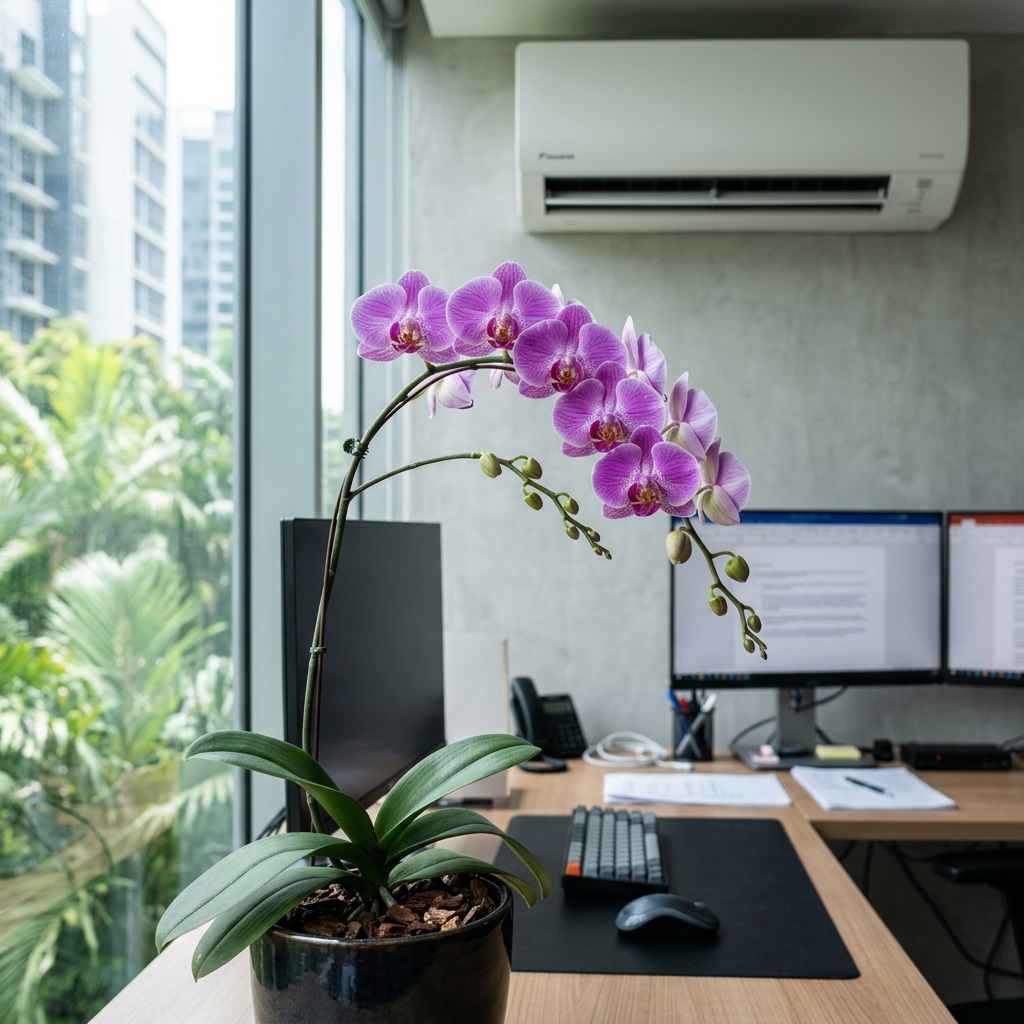
How to make a phalaenopsis rebloom in Singapore aircon
May
Almost all tips about phalaenopsis reblooming found online have been written with temperate homes in mind; that is, they take into account the changing seasons and seasonal temperature variation, cool winters, and hot summers. None of these apply to a typical Singapore home where it is cool, humid, and there isn’t really any significant dip in temperature, except for those caused by the air-con. This does not mean that you cannot get your orchid to rebloom in Singapore. It means the strategy will be different.
First, what’s actually happening to your orchid
When the last flower drops off the spike, your phalaenopsis isn’t dying. It’s resting. The plant has spent the last six to eight weeks pushing energy into showy blooms; now it needs to rebuild reserves before it can do that again. Healthy phalaenopsis can rebloom multiple times across their lifespan — many of ours have been through five or six bloom cycles by the time they leave the nursery permanently. The skill is recognising what stage your plant is in and giving it the right inputs at the right time.
Three signs the plant is healthy and just resting:
- The leaves are still firm and green, not soft or yellowing from the base
- The roots inside the pot are silvery-green or plump white when you water — not brown, mushy, or shrivelled
- There’s at least one new leaf that’s appeared in the last few months, even if it’s small
If all three are true, your plant is fine. It’s just between bloom cycles. The reblooming process from here typically takes two to three months — longer if conditions aren’t quite right, faster if they are.
The single most important rebloom trigger in Singapore: night-time temperature drop
Regardless of whether you recall the rest of the advice in this guide, please keep this section in mind. Phalaenopsis flowers were designed in habitats where there is a substantial difference between night-time temperatures and day-time temperatures. In temperate climates, seasonal changes induce such a variation naturally. In tropical nations like Singapore, however, there isn’t such a natural change. Our days and nights have little temperature variance.
The aim: To create a consistent difference in temperature of about 5 to 7 degrees Celsius between day and night time temperatures that lasts between two to four weeks. The majority of failed attempts to rebloom your phalaenopsis in Singapore aren’t due to incorrect handling by the subscriber; rather, they fail because the subscriber did not realize this temperature difference was the primary trigger.
How to create the temperature difference using your aircon system
- Position the orchid in a space where you can cool your room via air conditioning during the night. Bedrooms are excellent locations since almost everyone aircon their bedrooms overnight. Living rooms are also good options if you cool them during the evening.
- Set your aircon to a nighttime temperature of between 22 to 24 degrees celsius. Allow the room temperature to increase naturally to about 28 to 30 degrees celsius throughout the day, which should be normal room temperature in Singapore.
- This process should last no less than three weeks. Flowering isn’t a straightforward transition, and it requires sustained exposure to the temperature difference before your orchid decides to produce a flower spike.
- Place your orchid in an area away from the aircon vent. If you position it close to or directly beneath the vent, the dry air coming out will stress your plant.
You cannot use aircon at night to achieve this temperature difference. And this is usually the reason why Singapore subscribers struggle to rebloom their phalaenopsis flowers. However, there are alternatives, and we will discuss them in subsequent sections.
The second trigger: bright, indirect light
Watering during the rebloom phase
Fertilising — yes, but lightly
Phalaenopsis are slow feeders, and they do not require large amounts of nutrients, which means that too much fertilizer during the rest period will harm the roots more than benefit the flowering process. This rule applies to temperate climates; however, it becomes redundant in Singapore’s hot and humid climate, where growth rate slows down.
Fertilizer requirements: a specialized orchid fertilizer that is preferably labeled specifically for phalaenopsis or contains a 20-20-20 nutrient composition (N-P-K ratio). One should use one-quarter of the manufacturer’s recommended dosage twice a month during the rest period.
As soon as one notices the flower spike forming, all fertilization stops because it will only harm the newly formed tissues and will not benefit them at this stage.
What to expect, and the timeline
With all of that set correctly, here is about what to expect:
- Weeks 1-3: nothing happening. Plant still dormant.
- Weeks 4-6: possibly a little growth will appear at the bottom end of the plant as a new leaf or a thickened green stalk – if it’s not one of those things, it may be a flower stalk beginning to form. Either way, leave it alone!
- Weeks 6-10: if it’s a flower stalk that’s growing, it will begin looking very different from the other plant growth – growing vertically (contrary to gravity) with an elongated mitt-shaped point instead of the rounded point of a leaf or root.
- Weeks 10-14: flower stalk grows, budding nodes develop along it and it reaches maturity before the buds open.
- Weeks 14-18: buds open in succession, from the lower nodes to upper nodes – the new blooming cycle of the plant.
What to do if nothing happens after three months
If you’ve followed everything above and still see no spike after three months, work through this short list:
- Inspect the roots. Browning, mushiness, or shrinkage in roots indicates root rot or dehydration. This condition has to be addressed before you see the next bloom. Learn about orchid root rot here.
- Examine the foliage. Yellowing beginning at the bottom of the stem is an indicator of unhealthy plants. Wilting leaves indicate dehydration and should be addressed. Both are problems more serious than flowering.
- Ensure a cool temperature. Many people lower their aircon to 25°C, assuming this is cool enough. It is usually not cool enough because the aircon does not reach its set temperature in many Singaporean households; the temperature usually ends up between 26–27°C. Try setting it to 22-24°C.
- Look at your location. A cool temperature cannot overcome lack of light for blooming. Put the orchid somewhere where there is more light to try blooming again.
- Be patient. Healthy phalaenopsis may require four to six months between flowerings. Don’t assume it’s a problem right away.
When it’s actually time to give up
Sometimes the answer is that the plant is genuinely past its productive life or has a problem reblooming care can’t fix. Honest signs:
- All the leaves have yellowed and dropped, leaving only the bare base
- The roots are uniformly brown, dry, and brittle when checked
- The plant has been in decline for six months despite correct care
- There are signs of pest infestation (sticky residue, visible mealybugs, severe leaf damage) that haven’t responded to treatment
If any of these are true, this particular plant is unlikely to rebloom regardless of what you do. The good news: if you’re a phalaenopsis subscriber with us, we replace it at the next rotation at no charge — that’s how the subscription is designed to work. If you’re not a subscriber, this is roughly the point where most people would buy a fresh plant.
Quick reference: the rebloom checklist
If you want one section to bookmark, this is it. Print or save.
- Temperature: 5–7°C night-day differential, sustained for at least 3 weeks. Aircon target 22–24°C overnight.
- Light: bright indirect — soft shadow when you hold your hand above the leaves at midday.
- Water: every 7–10 days, only when roots are silvery-green. Drain fully, never let pot sit in water.
- Fertiliser: balanced orchid fertiliser at quarter strength, every 2 weeks. Stop when spike emerges.
- Patience: expect 2–4 months between blooms. Some healthy plants take longer.
Common questions
Should I cut the old flower spike after the blooms drop?
Maybe. If your spike has turned brown and dry, snip it off at the base – no more for now. If it’s still green, you don’t need to. Some phalaenopsis are capable of blooming again from another spike that grows off the original one at a node. This helps you get faster flowers than growing new spikes altogether. Snip just above a node if you want this.
Can I use ice cubes to water my orchid like I’ve seen online?
No. Using ice cubes for watering your plant is part of a viral marketing ploy, which became too widespread to shut down. Phalaenopsis are tropical flowers that like room-temperature water. No cold shock is needed – you need to drop the temperature through the air, not through the root system.
My orchid is in a south-facing window with afternoon sun. Is that okay?
Most likely, no. If you live in Singapore, you know that south-facing sunburns your plants’ leaves. Move it away from direct sunlight, cover your windows with sheers, or move it to an east- or north-facing window instead. Sunburned phalaenopsis leaves cannot recover – they’ll remain on the plant forever.
Do I need to repot the orchid before it’ll rebloom?
Typically, no. Repot only if the substrate has decomposed completely (musty smell, retains water too well, crumbles when touched). Also repot when the roots are too large for the current container. Subscription orchids at the nursery have been rotated, and our team repots those as needed. Thus, the first subscription delivery will be repotted appropriately. If you have a specific orchid that hasn’t been repotted for over a year, this might become an issue.
Can I encourage reblooming with humidity?
Singapore climate is humid enough on its own. You don’t need additional humidity, since it encourages fungal growth. Focus on dropping temperatures and nothing else.
My phalaenopsis was a gift. Will it rebloom too?
Yes. Gift orchids follow the exact same requirements as any other phalaenopsis. There is no difference whatsoever. All reblooming advice applies to all phalaenopsis regardless of their origin. If you want your orchid rebloom on regular basis, consider subscribing to orchid rotations.
Getting a phalaenopsis to rebloom in Singapore aircon is not hard – but it needs to be done with intentionality. The most critical thing that most people usually underestimate in their attempt is temperature drop at night time. Get your night temperatures right, provide plenty of light to your plant, water sparingly, and wait patiently for a few weeks; you will soon witness a spike!
If getting your plant to rebloom sounds like too much trouble for you – and this is true for quite a number of people – that is precisely the reason for subscribing to phalaenopsis flowers. We do all the reblooming for you at our nursery and send fresh blooming flowers after every six to eight weeks. Your old plant goes back to rest while another color comes into your possession. All depends on what works best for you.
